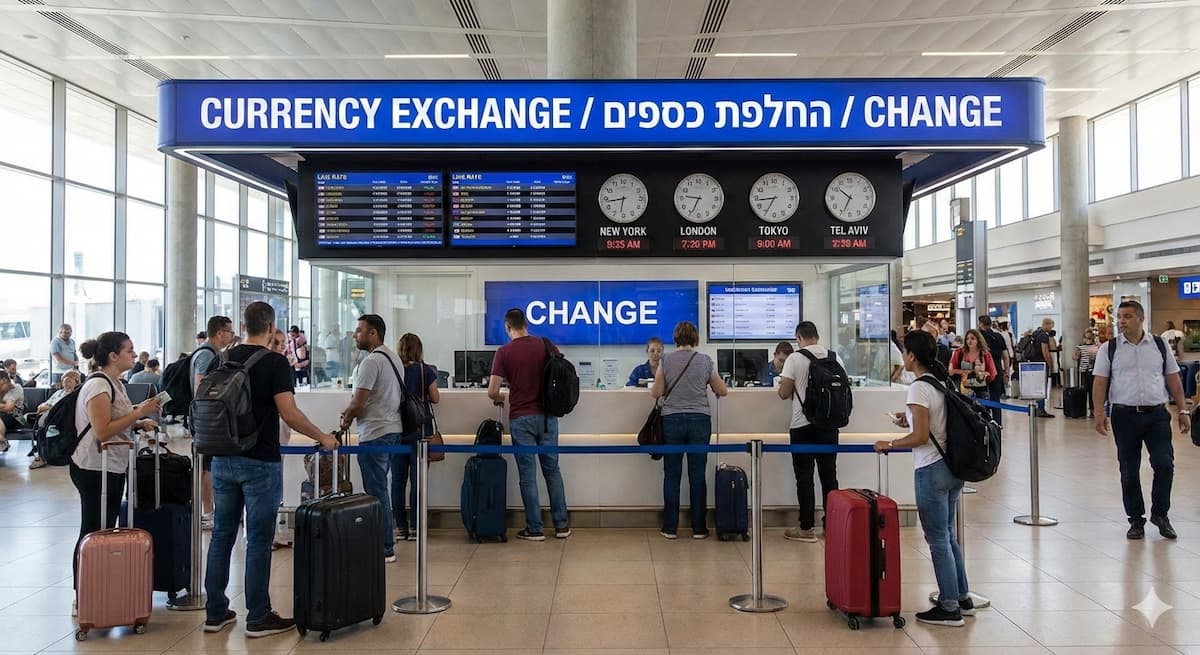
TL;DR: Don\'t exchange currency at Ben Gurion or at the bank — it\'s the most expensive option. CHANGE shops, Israel Post, and Wise offer better rates. Abroad, always pay in the local currency (refuse DCC), prefer credit cards, and withdraw cash from ATMs. Amounts over 50,000 NIS must be declared at customs. This guide covers where to exchange, how much cash to bring, and how to avoid hidden fees.
Even in the digital age, cash is still essential when traveling abroad. The question is how much to take and where to exchange to avoid losing money on unnecessary fees.
Why Do You Need Cash?
- Small businesses - Markets, stalls, family shops and small restaurants don't always accept cards
- Taxis - In many countries drivers prefer (or require) cash
- Tips - At hotels, restaurants and for tour guides
- Emergencies - Card blocked? Battery dead? Cash always works
How Much Cash to Take?
These amounts are recommendations for the start of your trip - you can always withdraw more from ATMs at your destination.
- Western Europe, North America - $100-200 for emergencies, pay the rest by card
- Eastern Europe, South America - $200-400 for daily use
- Asia, Africa - $300-500 (cash is more common, ATMs harder to find)
Don't keep all your money in one place! Split your cash between your wallet, pocket, luggage and hotel safe. That way if your wallet gets stolen - you haven't lost everything.
Where to Exchange - Comparing Options
There are several options for currency exchange, each with pros and cons:
1. Money Changers (Best Option)
Money changers usually offer the best exchange rates. The rate is close to the Bank of Israel representative rate with a small margin.
- Pros: Good rate, no additional fee, fast
- Cons: Requires physical visit, not always open
2. Banks
Banks offer orderly service but with higher fees.
- Pros: Reliability, ability to order rare currencies in advance
- Cons: Worse rate, exchange fee ($4-8), limited hours
Note: Banks charge a fixed exchange fee (usually $4-8) in addition to the rate spread. For small amounts, this can be 5%-10% of the total!
3. Digital Apps
Services like Wise (formerly TransferWise) offer exchange at the real mid-market rate with transparent fees.
- Pros: Excellent rate, convenient, card that can be used directly abroad
- Cons: Requires advance registration, not always instant
4. Airport (Most Expensive Option)
Exchange at the airport is the most expensive option - usually 5%-10% more than the real rate.
- Pros: Convenient, always open
- Cons: Very poor rate, high fees
| Option | Rate | Convenience | Recommendation |
|---|---|---|---|
| Money Changer | ⭐⭐⭐⭐⭐ | ⭐⭐⭐ | 👍 Recommended |
| Wise | ⭐⭐⭐⭐⭐ | ⭐⭐⭐⭐⭐ | 👍 Recommended |
| Bank | ⭐⭐⭐ | ⭐⭐⭐⭐ | OK |
| Airport | ⭐ | ⭐⭐⭐⭐⭐ | ❌ Avoid |
Exchange at Ben Gurion Airport
If you still need to exchange at the airport, here are the options:
Exchange Counters
There are several exchange counters at Ben Gurion:
- Before security - In the departures hall (Terminal 3)
- After passport control - In the duty-free area
- In arrivals hall - Before exit
ATMs at Ben Gurion
There are ATMs from Israeli banks throughout the airport. You can withdraw shekels before your flight.
Tip: If you forgot to exchange before the trip, it's better to withdraw cash from an ATM at your destination (see below) than to exchange at the Israeli airport.
Getting Cash at Destination
There are two main options for getting local currency at your destination: ATM or exchange counter. Which is better? Depends on the country.
In Asia (Thailand, Vietnam, Indonesia, etc.)
CHANGE counters in the city (not at the airport!) offer excellent rates - sometimes better than ATMs.
- Bring dollars from Israel ($50 and $100 bills get better rates)
- Look for reputable exchange offices like SuperRich in Bangkok
- ATMs in Asia charge high fees (150-220 Baht in Thailand = $5-7)
In Europe and North America
ATMs are usually better than street exchange counters.
- Good Visa/Mastercard rate
- Lower ATM fees
- Street exchange counters often charge high fees
ATM Withdrawal Costs
- Your Israeli bank's fee: $3-6 per withdrawal
- Local ATM fee: varies by country ($2-7)
Tip: Withdraw a larger amount at once to save on fees.
Always choose to pay/withdraw in local currency!
ATMs and payment terminals abroad sometimes offer "dynamic currency conversion" (DCC) - to charge you in your home currency instead of the local currency. This is a trap! The rate they offer is 3%-7% worse than your credit card rate.
Always press "Local Currency".
ATM Withdrawal Tips
- Withdraw larger amounts - Fixed fee per withdrawal, so better to withdraw once
- Use bank ATMs - Avoid independent ATMs that charge high fees
- Check withdrawal limits - Some cards limit daily withdrawals abroad
- Notify your bank - That you're traveling abroad, to prevent card blocking
Credit Cards Abroad
Credit cards are the most convenient and cost-effective way to pay abroad:
Credit Card Fees
| Fee Type | Amount |
|---|---|
| Foreign currency fee | 2%-2.5% of transaction |
| Buy/sell rate spread | ~1% |
| Total cost | ~3%-3.5% |
Recommended Cards for Travel
- Wise (debit) - No exchange fee, real exchange rate. Available for Israeli residents.
Cash Limits - What's Allowed?
Is There a Limit on How Much Cash I Can Take?
There's no limit on how much cash you can take in or out of Israel. You can travel with any amount. However - above a certain amount you must declare it.
When Do You Need to Declare?
- Leaving Israel - Over 50,000 NIS (or equivalent in foreign currency)
- Entering Israel - Over 50,000 NIS (or equivalent in foreign currency)
Failure to declare is a criminal offense that can result in confiscation of the money and fines.
How to Declare (Customs Form 84)
Where to get the form?
- Download in advance from the Israel Tax Authority website
- Get from the customs officer at the airport
Where to submit?
- Leaving Israel - To customs officer in departures hall
- Entering Israel - To customs officer in arrivals hall (red lane)
- If no officer available - Send by registered mail within 72 hours to: National Center for Money Laundering Prevention, Customs and VAT Directorate, P.O. Box 320, Jerusalem 9100202, Israel
Limits in Other Countries
- Europe (EU) - Declaration required over €10,000
- USA - Declaration required over $10,000
- UK - Declaration required over £10,000
Failure to declare cash over the allowed amount can lead to seizure of the money, heavy fines and even criminal investigation. If you're traveling with a large sum - declare it!
Money-Saving Tips
Before Your Trip
- Exchange at a money changer - Not at a bank or airport
- Open a Wise card - For good exchange rates
- Check the official rate - At your central bank website for comparison
- Research your destination - In some countries (Asia) local exchange is better
During Your Trip
- Pay by card - Wherever possible
- Refuse DCC - Always pay in local currency
- Withdraw larger amounts - To save on fees
- Avoid airport exchange counters - Both at origin and destination
On Return
- Use leftover currency - At duty free or supermarket at destination
- Don't exchange small coins - The fee is too high
- Keep large bills - For your next trip to the same destination
Want to check your flight?