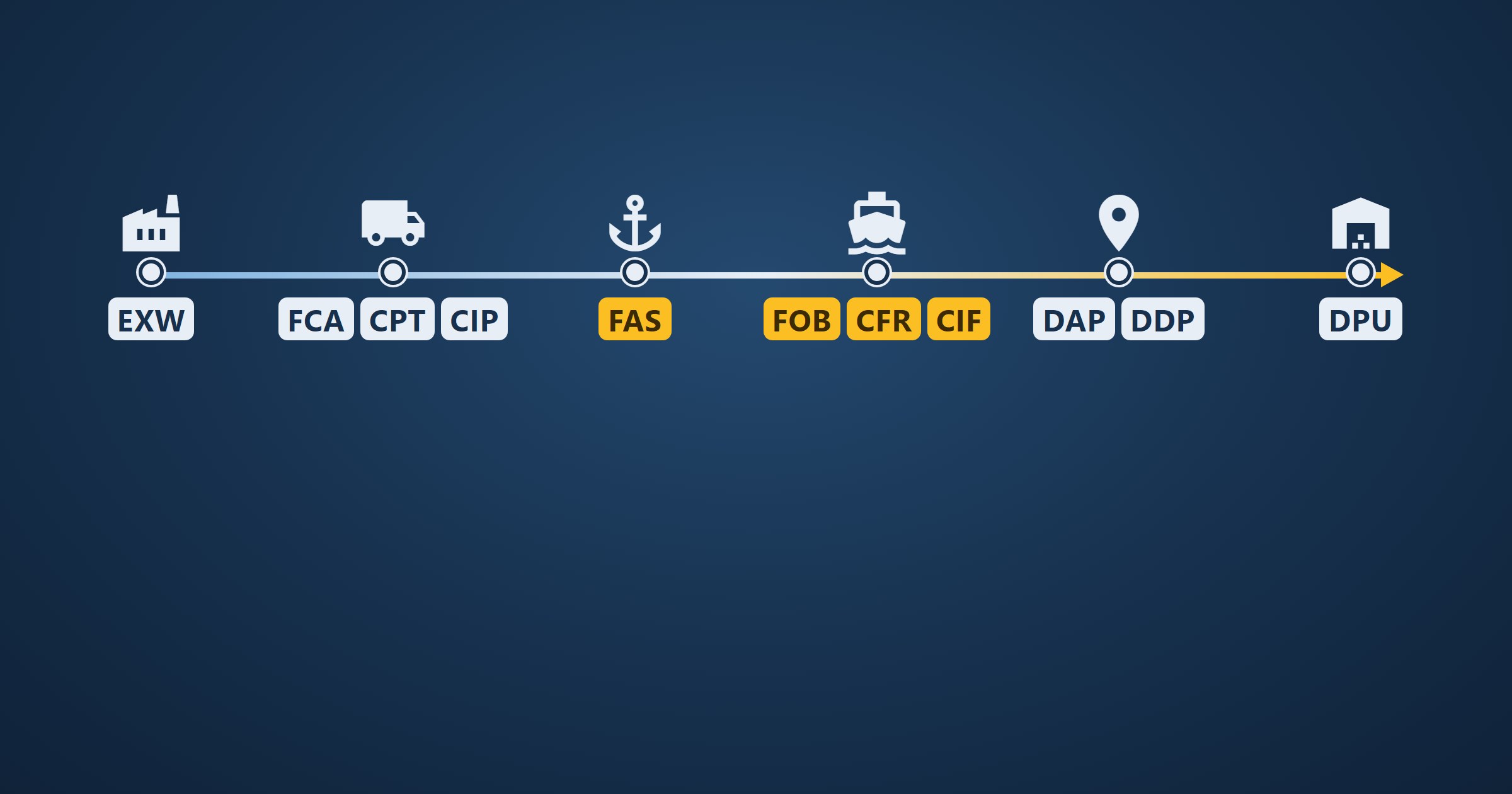
TL;DR: Incoterms are rules published by the International Chamber of Commerce (ICC). In a sale between a buyer and a seller they set out who arranges transport and insurance and who handles customs, where and when risk passes from the seller to the buyer, and who pays which costs. The current version is Incoterms® 2020. Seven of the rules suit any mode of transport, air included, and four (FAS, FOB, CFR, CIF) are meant for sea and inland waterway transport.
Incoterms® (International Commercial Terms) are rules published by the International Chamber of Commerce (ICC). According to the ICC they describe three things: obligations, who does what as between seller and buyer (for example who organises carriage or insurance and who obtains shipping documents and export or import licences); risk, where and when the seller "delivers" the goods and risk passes to the buyer; and costs, which party is responsible for which costs, for example transport, packaging, loading and unloading.
What are Incoterms?
Incoterms® 2020 is the current version, and it entered into force on 1 January 2020. The ICC's workplan for 2026 says work is beginning on the next revision, Incoterms® 2030. The ICC divides the rules into two groups:
- Rules for any mode of transport: EXW, FCA, CPT, CIP, DAP, DPU, DDP
- Rules for sea and inland waterway transport: FAS, FOB, CFR, CIF
Rules for Any Mode of Transport
EXW - Ex Works (Named Place of Delivery)
The seller delivers when it places the goods at the buyer's disposal at a named place (like a factory or warehouse), which may or may not be the seller's premises. The seller does not need to load the goods on the collecting vehicle or clear them for export. Export, transit and import clearance are for the buyer to carry out and pay for.
FCA - Free Carrier (Named Place of Delivery)
The seller delivers the goods to the carrier or another person nominated by the buyer, at the named point (if any) at the named place.
CPT - Carriage Paid To (Named Place of Destination)
The seller contracts a carrier and pays for carriage to the named destination. It delivers the goods, and risk passes to the buyer, when they are handed over to the carrier. Where the parties have not agreed a specific point of delivery, according to the ICC risk passes on delivery to the first carrier.
CIP - Carriage and Insurance Paid To (Named Place of Destination)
Like CPT, and the seller also insures the goods. Under Incoterms® 2020 the CIP insurance is extensive cover, under Institute Cargo Clauses (A) or a similar clause, and the parties may agree on a lower level of cover.
DAP - Delivered at Place (Named Place of Destination)
The seller delivers the goods, and risk passes to the buyer, when they are placed at the buyer's disposal on the arriving means of transport, ready for unloading, at the named place of destination. The seller clears the goods for export and has no obligation to clear them for import, pay import duty or carry out import customs formalities.
DPU - Delivered at Place Unloaded (Named Place of Destination)
The seller delivers the goods, and risk passes to the buyer, once they have been unloaded from the arriving means of transport and placed at the buyer's disposal at the named place of destination. According to the ICC this is the only rule that requires the seller to unload the goods at destination, and where the parties do not want the seller to bear the risk and cost of unloading, the ICC recommends DAP instead. In Incoterms® 2020 DPU replaced DAT (Delivered at Terminal), to make clear that the destination can be any place and not just a terminal.
DDP - Delivered Duty Paid (Named Place of Destination)
The goods are placed at the buyer's disposal on the arriving means of transport, ready for unloading, at the named place of destination, already cleared for import. The seller is responsible for import duty and taxes, and according to the ICC this is the rule imposing the maximum level of obligation on the seller of all eleven rules. It carries no insurance obligation.
Rules for Sea and Inland Waterway Transport
According to the ICC, these four rules are intended for use where the seller places the goods on board a vessel (or, in FAS, alongside it) at a sea or river port.
FOB - Free on Board (Named Port of Shipment)
The seller delivers the goods on board the vessel nominated by the buyer at the named port of shipment. Risk passes when the goods are on board, and from that moment the buyer bears all costs.
CFR - Cost and Freight (Named Port of Destination)
The seller delivers the goods on board the vessel and contracts for their carriage to the named port of destination. Risk passes when the goods are on board, and the seller has no obligation to insure the goods for the buyer.
CIF - Cost, Insurance and Freight (Named Port of Destination)
Like CFR, and the seller also insures the goods. Under Incoterms® 2020 the CIF insurance is limited cover, under Institute Cargo Clauses (C) or a similar clause, and the parties may agree on a higher level of cover.
FAS - Free Alongside Ship (Named Port of Shipment)
The seller delivers when the goods are placed alongside the ship nominated by the buyer (for example on a quay or a barge) at the named port of shipment. Risk passes when the goods are alongside the ship, and from that moment the buyer bears all costs.
Air Freight and Containers: What the ICC Says
- As an example of choosing the wrong rule, the ICC gives an FOB contract at an inland point, such as an airport or a warehouse, and says it "makes little sense".
- Where the goods are handed over to the carrier before they are on board, for example at a container terminal, FOB is not appropriate, and the ICC says the parties should consider FCA instead.
- Where more than one mode of transport is used, for example when goods are handed over to a carrier at a container terminal, the ICC says the appropriate rule is CIP rather than CIF.
- The ICC recommends naming the port, place or point as precisely as possible, and writing the rule, the place and the year into the contract, for example "FCA Ben Gurion Airport Incoterms® 2020". According to the ICC, leaving the year out could cause problems that may be difficult to resolve.
Quick Reference: The Seller's Obligations
| Rule | Export | Carriage | Insurance | Import |
|---|---|---|---|---|
| Any mode of transport | ||||
| EXW | - | - | - | - |
| FCA | ✓ | - | - | - |
| CPT | ✓ | ✓ | - | - |
| CIP | ✓ | ✓ | ✓ | - |
| DAP | ✓ | ✓ | - | - |
| DPU | ✓ | ✓ | - | - |
| DDP | ✓ | ✓ | - | ✓ |
| Sea and inland waterway transport | ||||
| FAS | ✓ | - | - | - |
| FOB | ✓ | - | - | - |
| CFR | ✓ | ✓ | - | - |
| CIF | ✓ | ✓ | ✓ | - |
✓ means the seller is obliged to do it; Export and Import mean customs clearance. According to the ICC, the seller has an insurance obligation only under CIP and CIF, export clearance falls on the buyer only under EXW, and import clearance falls on the seller only under DDP.
Importing into Israel: Sale Terms and Customs Value
In the Israel Tax Authority's customs handbook, chapter 2 (valuation, in the version of 30 March 2017), the assessor checks that the shipping or delivery terms on the bill of lading match those on the supplier's invoice. Where the import documents do not state the terms of sale, the transaction is treated as EXW. The assessor also checks that freight and insurance were included in the declared value, and under section 133(a)(5) of the Customs Ordinance the cost of carrying the goods to the port or place of import is added to the transaction value.
Sources: International Chamber of Commerce (ICC): the Incoterms® 2020 book in its Digital Library, and the Incoterms® pages on its website. Israel Tax Authority: the customs handbook, valuation chapter.
Incoterms® is a trademark of the International Chamber of Commerce (ICC). This guide is for information only and is not legal advice.
Want to check your flight?