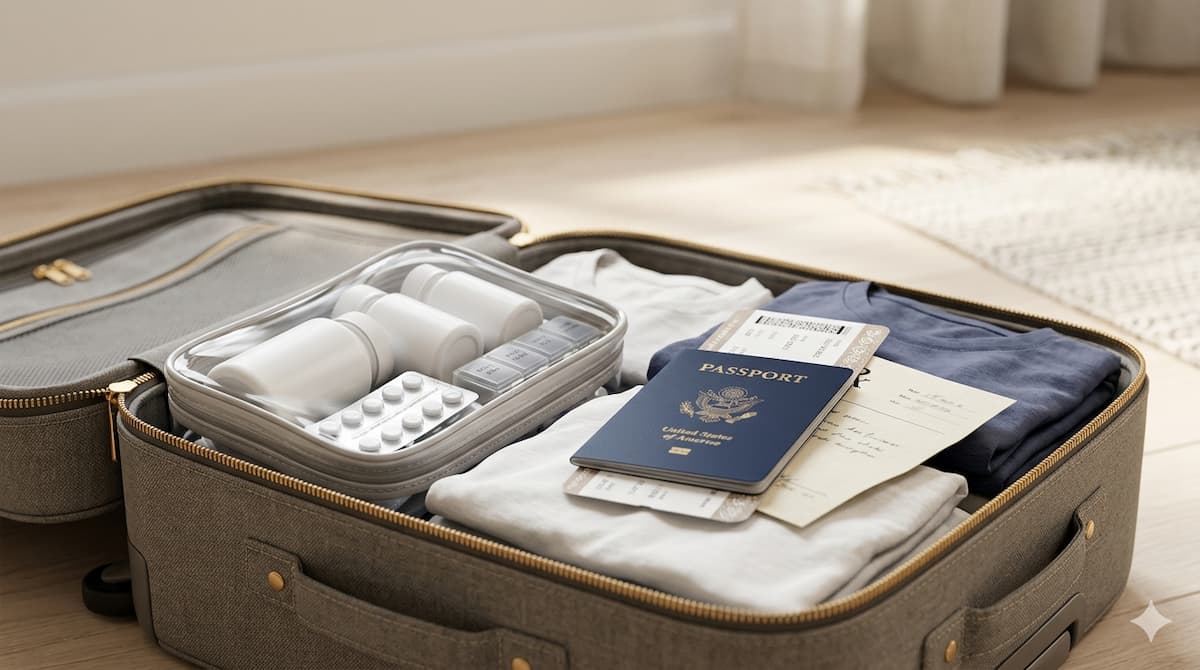
TL;DR: According to Israel's Ministry of Health, you may bring medicines for personal use into Israel up to a three-month (90-day) supply. Medicines containing a narcotic or psychotropic substance are allowed in a quantity of up to 31 days, with a copy of a valid prescription, in the original package and with a "certificate for carrying" from the health authority of your country of residence. This guidance does not cover cannabis products.
Personal Medicines: How Much You Can Bring
According to the Ministry of Health, travellers may bring medicines in a quantity that meets ordinary personal needs, and ordinary personal need is a supply of up to three months (90 days) at the recommended dosage for each medicine. This does not apply to narcotic drugs and psychotropic substances, which have their own rules (below).
The rule is the same whether the medicine was taken out of Israel and is being brought back, or was bought abroad.
A product bought abroad must meet Israeli legislation even if it is not considered a medicine abroad. Products sold freely abroad, such as dietary supplements and vitamins, may be classified as medicines in Israel, especially when medicinal properties are attributed to them.
Controlled Medicines and the Certificate
According to the Ministry of Health, people arriving in Israel may carry substances listed in the Dangerous Drugs Ordinance, or in the Ministry's tables, in a quantity sufficient for 31 days. The form Israel filed with the International Narcotics Control Board (INCB) also lists 31 days for narcotic drugs and 31 days for psychotropic substances.
1. A copy of a valid prescription
2. The medicine in its original package
3. A "certificate for carrying" from the health authority of your country of residence
On its personal import page the Ministry of Health names it the "Certificate for the carrying by travelers under treatment of medical preparations containing narcotic drugs and/or psychotropic substances". A tourist entering Israel presents it to the customs officer on request.
Which substances Israel classifies as drugs
The Ministry of Health publishes a list of common substances it has been asked about, stating whether they are narcotic or psychotropic in Israel:
- Psychotropic substances: alprazolam, brotizolam, clonazepam, diazepam, lorazepam, oxazepam, zolpidem
- Narcotic drugs: methylphenidate, amphetamine, lisdexamfetamine, ketamine, morphine, cannabis, oxycodone
In an example the Ministry of Health gives, the medicine Vyvanse contains lisdexamfetamine. If the doctor has not told the patient whether a medicine is a drug, checking is the patient's responsibility, with Israel's competent authority at rok.import@moh.gov.il.
The UN Quantity Table
The Ministry of Health publishes, per UN (UNODC) guidance, a table of the quantities above which a certificate is needed. It appears in the Ministry's section on Israelis travelling abroad and is used to check the rules of destination countries. On entry to Israel the rule is up to 31 days. The classification in the table is the UN's, and on the Ministry of Health's list for Israel methylphenidate is classified as a narcotic drug. Some of the substances in the table:
| Substance | Type | Maximum (a certificate is needed above it) |
|---|---|---|
| Codeine | Narcotic | 12 g |
| Morphine | Narcotic | 3 g |
| Oxycodone | Narcotic | 1 g |
| Methadone | Narcotic | 2 g |
| Hydromorphone | Narcotic | 300 mg |
| Pethidine | Narcotic | 12 g |
| Fentanyl | Narcotic | 100 mg (patches) / 20 mg (other) |
| Methylphenidate | Psychotropic | 2 g |
| Buprenorphine | Psychotropic | 300 mg |
| Diazepam | Psychotropic | 300 mg |
| Lorazepam | Psychotropic | 75 mg |
| Oxazepam | Psychotropic | 1.5 g |
| Phenobarbital | Psychotropic | 6 g |
| Flunitrazepam | Psychotropic | 30 mg |
The Ministry of Health notes that rules differ between countries, and that some substances defined as drugs may not appear on the list. When in doubt it recommends checking with the prescribing doctor and the pharmacist. Country-by-country information is published on the INCB (International Narcotics Control Board) website.
Personal Import by Mail or Courier
A medicine ordered to Israel by mail or courier, rather than carried on a flight, goes through the "personal import" route. According to the Ministry of Health, the conditions are:
- The quantity does not exceed one person's 90-day supply;
- The product is registered and marketed in the country it is sent from;
- The product is not a dangerous drug under the Dangerous Drugs Ordinance and does not contain a psychotropic substance;
- The product was bought from a licensed pharmacy in the country of origin;
- The recipient signs a declaration (Form 1).
A signed, up-to-date medical certificate stating the need for the product, including the daily dose, may also be requested, even for a non-prescription product. For a product not registered in Israel, the Ministry of Health recommends going through licensed pharmacies and stores rather than personal import. The dangerous-drug and psychotropic restriction does not apply to a tourist entering the country with a "Certificate for the carrying by travelers".
Medical Cannabis
The Ministry of Health states that its information on carrying medicines does not cover cannabis products. On the Ministry of Health's list, cannabis is classified in Israel as a narcotic drug.
In Israel, patients who meet the criteria of Procedure 106 can receive a licence to possess and use medical cannabis. Questions go to the Ministry of Health's Medical Cannabis Unit (IMCA), on 08-6268000.
Layovers
According to the Ministry of Health, the guidance also covers layovers: anyone who leaves the airport during a layover should treat it as a destination country in its own right.
This article is based on Ministry of Health publications. According to the Ministry of Health, where the information conflicts with the law, the law prevails.
Sources: Israel Ministry of Health (Pharmaceutical Division and Medical Cannabis Unit), International Narcotics Control Board (INCB).
Flying to or from Tel Aviv?