TL;DR: Payment for buses and trains in Israel is by Rav-Kav card, not cash to the driver. The train station is on the ground floor (Level G) of Terminal 3, and the train reaches central Tel Aviv in about 20 minutes (about NIS 11.50, roughly USD 4). The train does not run on Shabbat: the last trains leave Friday before Shabbat begins, and service resumes shortly after Shabbat ends (the exact times shift with the season - summer or winter clock). Buses leave from Level 2 (Exit 21). On Shabbat and at night, taxis and shared taxis (sherut) are the main option. The facts here are based on the Israel Airports Authority, Israel Railways and Rav-Kav Online.
The Rav-Kav - How You Pay
In Israel, payment for buses and trains is made with a smartcard called the Rav-Kav, not in cash to the driver. It is the first thing a tourist meets in the public-transport system.
How you get one and load it:
- Buying the card: an "anonymous" Rav-Kav (no ID needed) is sold at a service point or a designated kiosk, for a small one-time fee.
- Loading value: the card holds stored value (NIS 30 to 300) from which each ride is deducted. Loading is possible at a kiosk, a Rav-Kav ATM (Casponet), or through the Rav-Kav Online app by holding the card to the back of a phone (NFC).
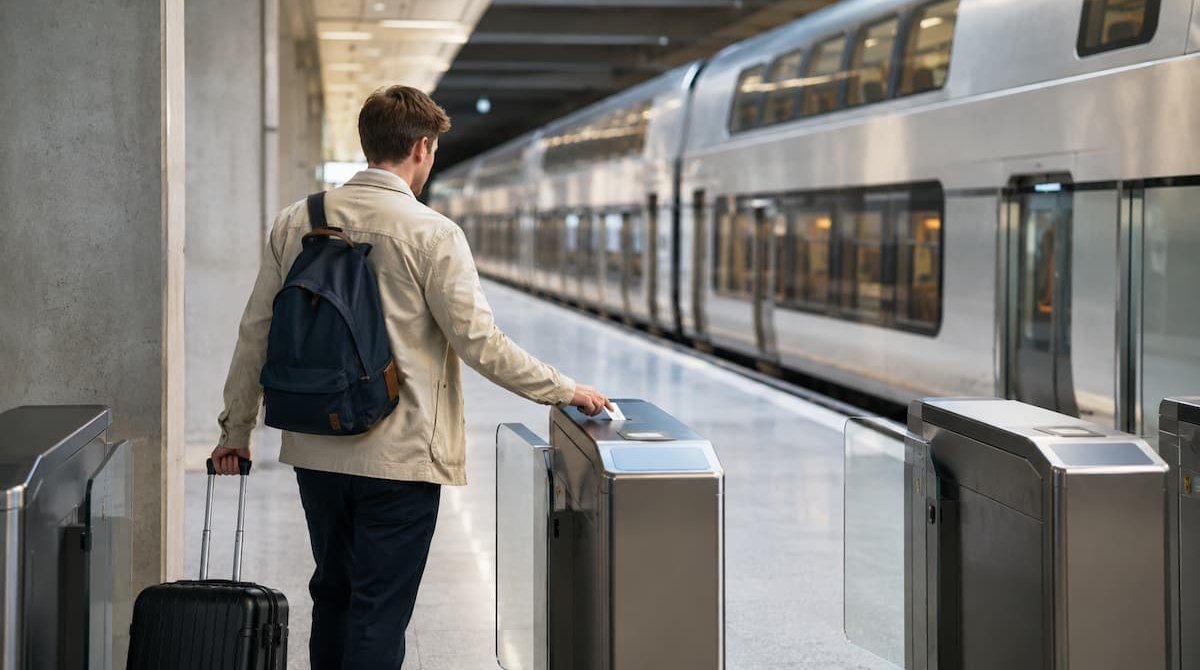
- Tapping on boarding: the card is held to the reader on the bus or at the train gate. On the train the tap is done on entry and on exit, and the fare is charged by distance.
For routes and times, Moovit and Google Maps are the common apps; the card is loaded through Rav-Kav Online.
Children under 5 ride free. Discounts exist for various profiles (student, senior citizen 67+ who rides free, discharged soldier), but most are aimed at Israeli residents and require setting up a personal profile.
Step by step: from landing to your first ride
- After passport control and collecting your luggage, you head to public transport: the train is on the ground floor (Level G) of Terminal 3, the buses on Level 2 (Exit 21).
- You sort out a Rav-Kav: a physical card can be loaded in advance through the Rav-Kav Online app (held to an NFC phone), or an anonymous card is bought and loaded with value at a service point, a kiosk or a Rav-Kav ATM (Casponet).
- You load stored value (loaded from a minimum of NIS 30 per top-up), or a daily pass if several rides are planned for the same day.
- On the train the card is tapped at the gate on entry and again on exit (charged by distance); on the bus it is tapped on the reader on boarding.
- The line and time are shown on Moovit or Google Maps.
The Train from Terminal 3
To most cities, the train is the fastest and cheapest option. Per the Israel Airports Authority the station is in Terminal 3, on the ground floor (Level G) of the terminal; you reach it directly from the arrivals hall, without leaving the building.
- Hours: Sunday-Thursday the train runs almost around the clock.
- Shabbat: the train does not run on Shabbat. The last trains leave Friday before Shabbat begins, and service resumes shortly after Shabbat ends. The exact times shift with the season (summer or winter clock), so it is worth checking the next departure on our live transport board. The same applies on Jewish holidays.
- To Tel Aviv: a ride to the city centre takes about 20 minutes. The Tel Aviv stations are HaHagana, HaShalom, Savidor Center and University. After midnight trains stop only at HaHagana and Savidor Center.
- Flying from Terminal 1? Someone who arrives by train at Terminal 3 and flies from Terminal 1 crosses between the terminals on the free internal shuttle.
Up-to-date timetables are on the Israel Railways website, at the railway information line (*5770) and in the navigation apps.
Want to see the next train and bus from Ben Gurion in real time (with live delay and platform)? Check our live transport board, which shows the upcoming departures to each destination.
Buses from the Airport
For destinations without a direct train there are buses. Per the Israel Airports Authority all bus lines leave from Terminal 3, Level 2 (at the exit from Gate 21):
- To Tel Aviv: line 445 (Kavim), connecting Ben Gurion to central Tel Aviv roughly once an hour (not on Shabbat).
- To Jerusalem: line 485 (Egged), and services by Afikim.
- To Be'er Sheva: a Metropoline service.
- Around the airport: line 5 (Egged), a shuttle between Ben Gurion, Airport City and the El Al Junction.
On the bus, too, payment is by Rav-Kav only, with no cash.
What It Costs
Public-transport fares in Israel are uniform and set by distance and travel zones. The dollar and euro figures are a conversion at the exchange rate when this article was written (about NIS 2.9 to the dollar, NIS 3.4 to the euro) and they change; you can check a current rate with our currency converter. Per the Rav-Kav Online fare table:
- A ride within the city: about NIS 8 (about USD 3 / EUR 2.4). Transfers between buses within the city are free for 90 minutes.
- Tel Aviv ⇆ Ben Gurion: a single ride about NIS 11.50 (about USD 4 / EUR 3.4), a daily pass about NIS 23 (about USD 8 / EUR 6.8).
- Tel Aviv ⇆ Jerusalem: a single ride about NIS 27 (about USD 9.5 / EUR 8), a daily pass about NIS 42.
- Tel Aviv ⇆ Haifa: a single ride about NIS 30.50 (about USD 10.5 / EUR 9), a daily pass about NIS 47.
Stored value is loaded from a minimum of NIS 30 per top-up; there is no special minimum balance to board a train beyond having at least the fare on the card. For many rides in one day, a daily pass is cheaper than several single rides.
Getting Around on Shabbat
A point that surprises many tourists: on Shabbat, from Friday afternoon until Saturday night, the train and most buses do not run. A traveler who lands on Friday evening or on Saturday will not find regular public transport.
What does run?
- A regular taxi from the official taxi rank: runs 24/7, including Shabbat (at a higher fare on Shabbat). Details in our taxi guide for Ben Gurion.
- A shared taxi (sherut): a large taxi on a fixed route, the cheapest and most common alternative to public transport on Shabbat.
On a Friday-night or Saturday flight, regular public transport is suspended, and the options are a taxi or a sherut. The train and buses resume at the end of Shabbat.
More Useful Details
- The Rav-Kav is sorted out before boarding a bus, since there is no cash payment.
- To Tel Aviv the train is usually faster and cheaper than a taxi, except on Shabbat.
- Moovit and Google Maps show the line, the time and the fare.
- Stored value is loaded from a minimum of NIS 30 per top-up; there is no special minimum balance to board a train beyond the fare itself.
- On Shabbat and at night, taxis and shared taxis are the main option.
This article is based on official sources: the Israel Airports Authority, Israel Railways and Rav-Kav Online. The amounts, exchange rates and times are estimates and are updated from time to time.
Flying to or from Tel Aviv?
Ben Gurion Arrivals · Ben Gurion Departures
Need to get to the city now? Live trains & buses from Ben Gurion →